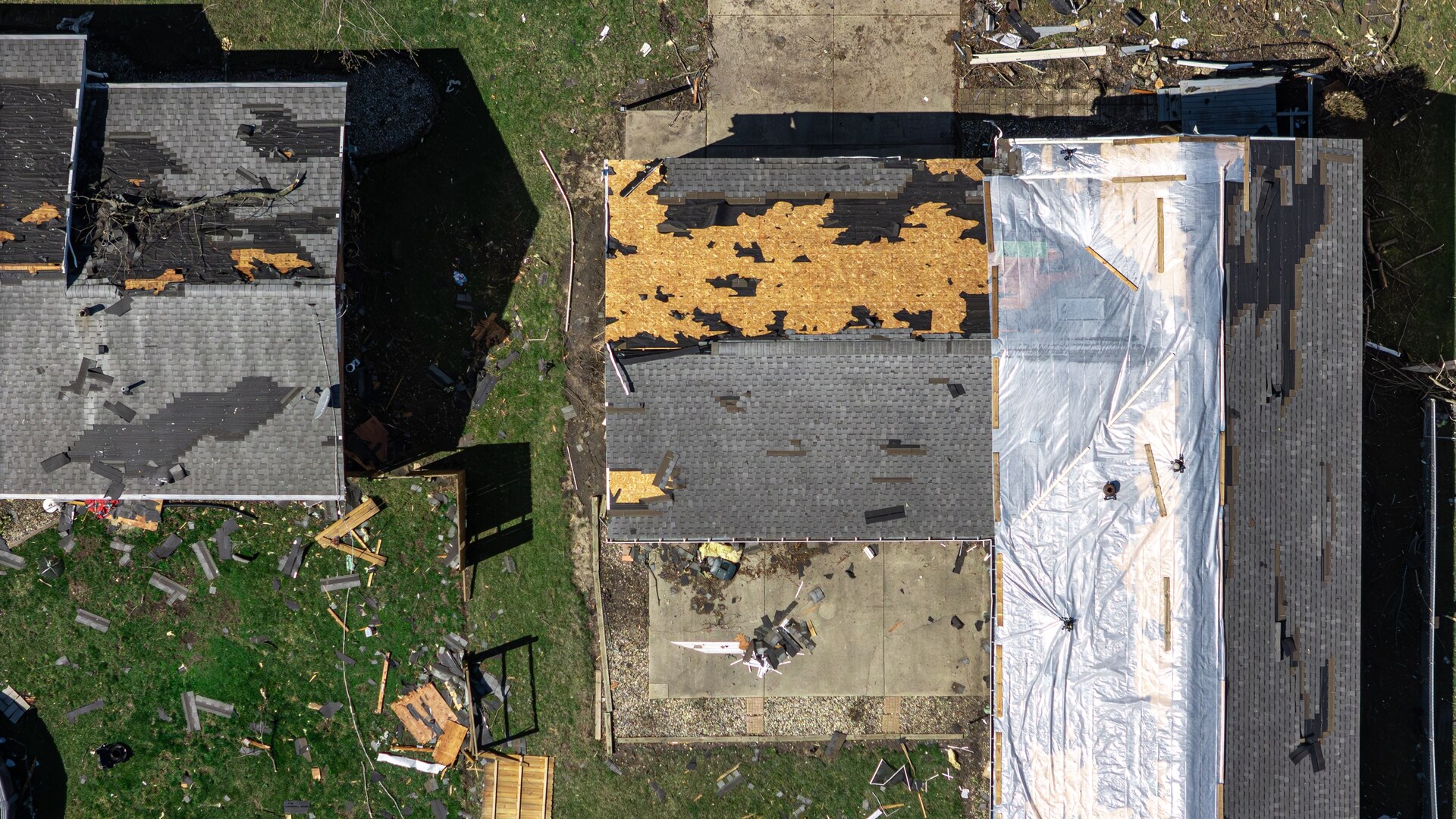
From the 2 a.m. call through to the last roll of sod — the entire exterior scope, on one file.
The repairs themselves are ordinary. What makes storm files difficult is extent — wind damage scatters. A single event will take a tree down on a garage, snap a leader over a pool, blow out forty feet of fence on the far property line, lift a section of pergola, and leave three more trees with cracked unions that nobody notices until the next system.
Scope only what's obvious and you get supplements, second mobilizations, and a file that reopens. Scope the whole property and the file closes once.
Life-safety hazards, trees on structures, blocked access. Exclusion zones, utility coordination where lines are involved, and temporary protection to stop water and further damage. Emergency tree removal →
Timestamped photography of the whole property before anything moves. Damage detail, failure points showing storm-consistent characteristics, and wide shots establishing pre-existing condition of undamaged areas.
Debris cleared, access restored, site made workable for the building trades. In parallel, a full property assessment covering every tree, every hardscape element, every structure, and the landscape. Storm-damaged tree cleanup →
Itemized scope for the full exterior, with a clear separation between emergency mitigation already performed and reconstruction proposed.
Sequenced so nothing gets finished and then driven over. Exterior restoration →
Completion photography from matched angles and a final invoice reconciled to the approved scope.
The trees still up after a storm are the next claim. Cracked unions, partial root-plate lift, one-sided crown loss leaving an unbalanced canopy. We assess at canopy level, not from the driveway.
Impact loads travel. A limb through a deck surface may have driven framing onto posts and loosened the ledger. We open up and check. Deck repair →
Falling debris fractures the base beneath interlock and concrete, and the surface can look sound over a broken base for months.
Wind loosens posts along a whole run, not only where a panel actually failed. Replacing three panels between compromised posts is a repair that fails within a year.
Root plates lifting and debris impact reroute surface water, and the resulting ponding causes damage months after the event.
Our own equipment damage during response, documented before mobilization and restored afterward. Landscape restoration →
When a system hits the whole region at once, everybody calls at once. We triage by severity — structures and life-safety first, blocked access second, cleanup third — and we tell you where you actually sit rather than promising a crew that isn't available.
For contractors and property managers with multiple affected sites: send the full list. We sequence it, report by address, and keep documentation separated per property. Volume work doesn't get volume documentation.
Within four hours under normal conditions. During widespread events, response is triaged — we'll give you a real position in the queue rather than an optimistic one.
Frequently, yes. Fresh tear-out in green wood looks different from an old decay column, and impact damage looks different from long-term settlement. We photograph what we find and report it accurately, including when it doesn't support the claim.
No. We handle everything outside the building envelope, plus temporary protection to prevent further loss. Roofing, siding and interior restoration belong to those trades, and we coordinate rather than overlap.
Yes — most of our storm volume comes that way.
We'll get you a documented, itemized scope for the entire exterior — trees, hardscape and landscape on one file. Scoping and photo documentation are no charge.