Fallen trees. Immediate action. 24/7 emergency dispatch. 24/7 emergency dispatch: (437) 567-2199

Green Care Earth
☎ (437) 567-2199
Home Tree Services Emergency tree removal Dangerous tree removal Storm-damaged tree cleanup Exterior Restoration Interlock removal & replacement Retaining wall repair Deck repair & reconstruction Concrete driveways & walkways Landscape Restoration Sod replacement Grading & drainage Post-construction restoration Insurance & Emergency Work Storm & wind damage Fallen tree property damage Emergency site cleanup About Us Gallery Blog FAQ Contact Us
Tree Services · Hazard trees

Dangerous Tree Removal

Leaning, split, hung up, or already resting on something that can't hold it. The removals other crews decline.

Request a hazard assessment Call (437) 567-2199

A dangerous tree is a physics problem before it's a cutting problem

Every tree that's failing is storing energy somewhere — in a bent stem, a partially torn union, a hanging limb caught in the canopy below it, or a root plate that's lifted and is now the only thing holding several tonnes at an angle. Cut in the wrong sequence and that energy releases somewhere nobody planned for.

That's why these removals get declined, and why they get quoted at wild numbers by crews who know they're out of their depth. We take them because we plan them: load assessment first, rigging plan second, saw last.

Trees we're called for

Leaners over structures

Root plate lifted, soil heaved on the opposite side, trunk at an angle it wasn't at last month. These fail with no further warning and they fail toward the lean.

Split trunks and torn unions

Codominant stems that have separated at the union, held together by a strip of bark and hope. Common after wind and ice, and unstable in a way that isn't visible from the ground.

Hangers and widowmakers

Broken limbs suspended in the canopy, often invisible from below and directly over a walkway, driveway or play area.

Trees over pools, roofs and neighbours

Where an open fell isn't an option and everything comes down on a rope, piece by piece, or on a crane.

Decay and cavity failures

Extensive internal decay, conks, hollow butts, or root rot — where the tree looks fine and has no meaningful holding wood left.

Line-adjacent trees

Anything within striking distance of primary or service conductors. Utility coordination happens before mobilization, not during.

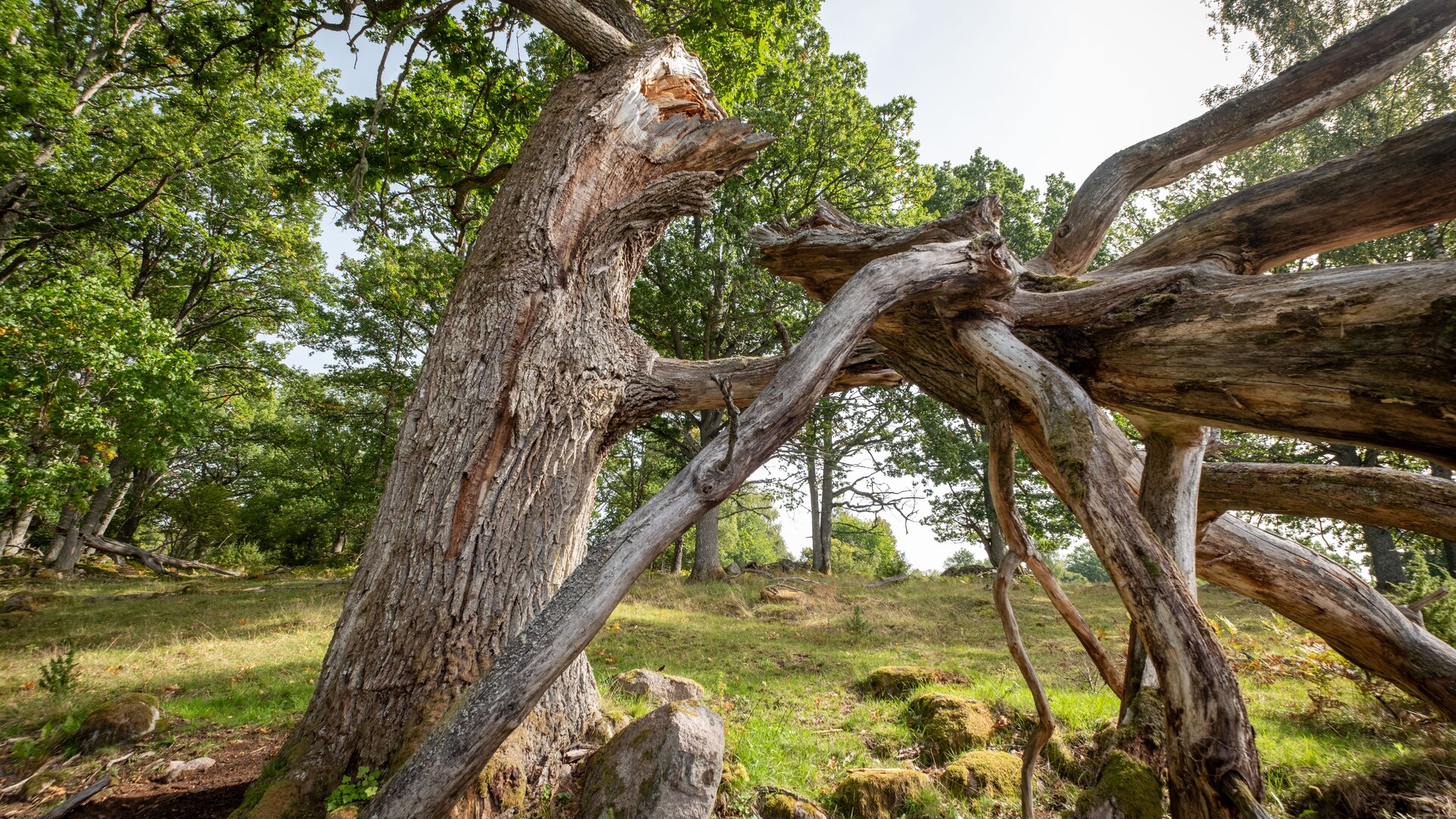
Failed oak with a torn union and split limbs resting on the ground

How we approach it

1

Assess before quoting

We look at holding wood, lean direction, target zones, access, and what's underneath. That assessment tells us whether this is a rigging job, a crane job, or a job that needs the driveway plated before a machine goes anywhere near it.

2

Plan the sequence

Which limb comes off first determines what the trunk does. On a compromised tree, the removal order is the safety plan.

3

Rig it down

Speed lines, blocks and lowering devices to bring sections down under control rather than dropping them. Slower, more expensive per hour, and the only way to remove a tree over a conservatory without paying for a conservatory.

4

Crane where it's warranted

For heavy picks over structures, a crane is often cheaper than the alternative once you price the risk. We'll tell you when it's justified and when it's not.

5

Protect the ground

Plating, matting and ground protection so the lawn, interlock and driveway survive the equipment. Anything we damage, we repair. Interlock repair →

For adjusters and property managers

Hazard trees are usually a liability question before they're a removal question. If a tree fails and injures someone or damages neighbouring property, the questions asked afterward are: was the defect visible, was it reported, and what was done about it.

We provide arborist-led written hazard assessments with photographs, defect descriptions, target analysis and a plain-language risk rating — documentation that supports a decision either way. If a tree can be retained with pruning or cabling, we'll say so; removal isn't always the answer, and recommending it when it isn't costs us credibility we'd rather keep.

Common questions

Is my tree actually dangerous, or does it just look bad?

Those are different questions. Dead trees away from targets can sometimes stay. Living trees over a bedroom with a split union usually can't. A hazard assessment answers it properly.

Can a dangerous tree be saved?

Sometimes — through crown reduction, deadwood removal, or cabling and bracing to support a weak union. It depends on the defect, the species, and what's underneath.

Do you need to bring a crane into the backyard?

Not usually — most technical removals are rigged from the tree. Cranes come out for heavy picks over structures where rigging can't safely control the weight.

Who's responsible for a tree on a property line?

Ownership generally follows where the trunk sits, and boundary trees have shared responsibility. It varies by municipality and gets contentious quickly. We'll work with both parties, but the legal question isn't ours to answer.

Related: Emergency tree removal · Storm-damaged tree cleanup · Insurance & emergency restoration

Send us the loss address

We'll get you a documented, itemized scope for the entire exterior — trees, hardscape and landscape on one file. Scoping and photo documentation are no charge.

Send loss details 24/7 dispatch: (437) 567-2199