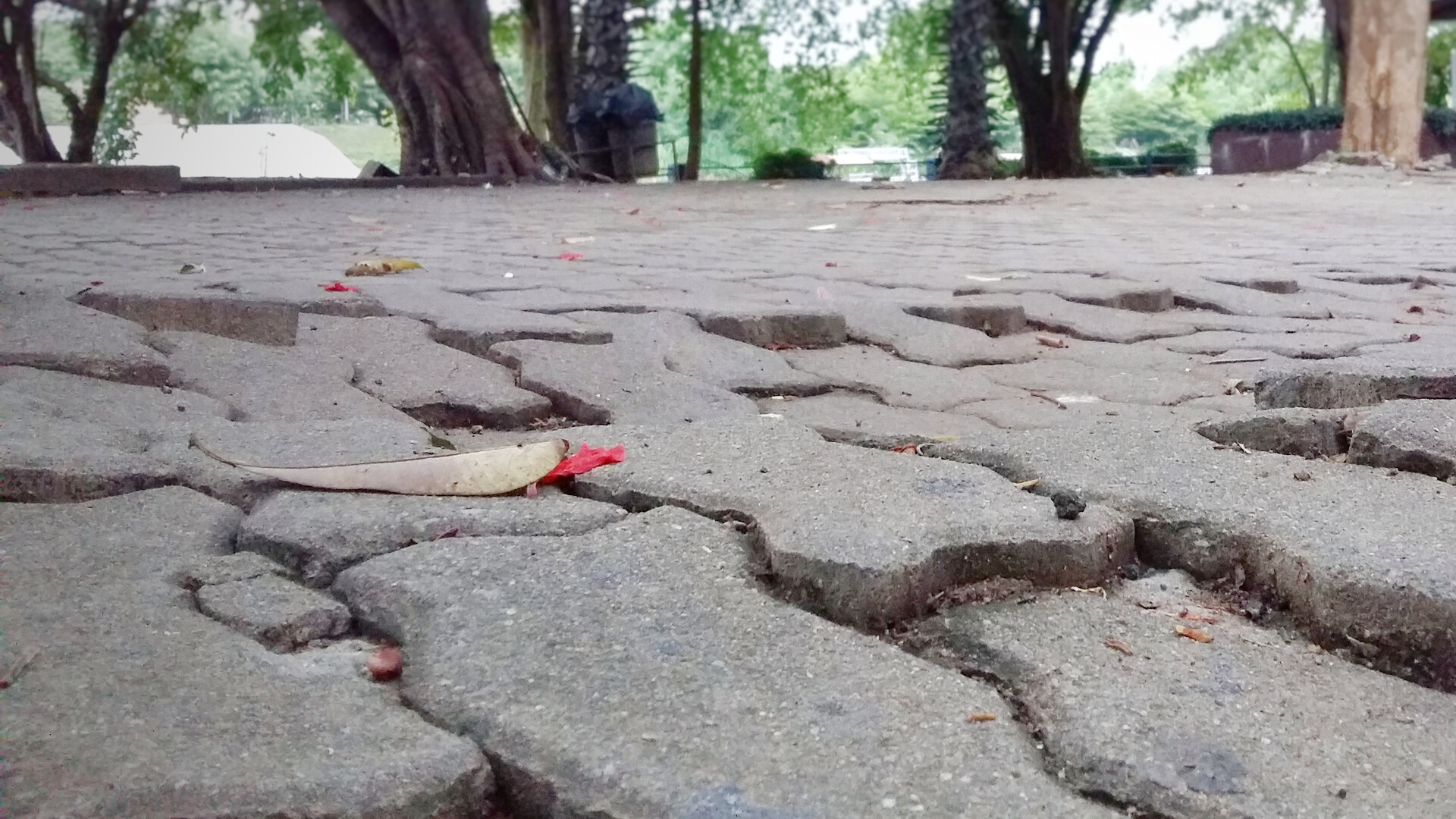
Settled, heaved, sunken or damaged pavers — lifted, re-based and relaid so the failure doesn't come back.
The pavers are usually fine. What failed is underneath: a base that was too thin, laid on unprepared subgrade, saturated because water had nowhere to go, or excavated and backfilled by somebody running a service line or removing a tree. The surface just shows you where the problem is.
Which is why relaying stone on a compromised base is throwing money at a symptom. It looks corrected for a season, then the same low spot reappears in the same place. On an insurance file, that becomes a callback and an argument about who owns it.
We rebuild from the subgrade up.
Root plates lift and crack interlock, and grinding stumps and chasing surface roots disturbs the base beneath. Both need the affected area rebuilt, not reset. Stump grinding →
Service line work, foundation repair, weeping tile and drainage installation all leave backfill that settles for years. Interlock over uncompacted backfill will sink; the only question is when.
Point loading from an impact displaces stone and fractures the base well beyond the visible damage.
Downspout discharge, failed grading and undermined edges wash out bedding sand and hollow the base from below. The surface holds until it doesn't.
Poor original base depth, no geotextile separation, no edge restraint — twenty-year-old work built to standards nobody follows now.
Pavers removed by hand and palletized for reuse where the product is intact and the colour still matches. Salvaging good stone is a meaningful line-item saving and we'd rather pass it on than sell you new product you don't need.
Failed base material out, down to something that will actually carry the load. Depth depends on use — pedestrian walkway, residential driveway, or a driveway that sees a delivery truck are three different builds.
If water is the reason, we fix the water: regrade, extend a downspout, install drainage. Rebuilding a base without addressing the source is a warranty claim waiting to be filed. Drainage corrections →
Geotextile separation over subgrade, granular base placed in lifts and compacted to specification with a plate or roller sized for the lift. Not dumped, spread and hoped for.
Bedding course screeded to consistent depth, stone laid to the original pattern, cuts made to the existing field so a partial repair reads as continuous.
Edge restraint on every free edge — the single most-skipped component and the reason edges spread and drift. Polymeric jointing sand, compacted, and swept clean.
Sod, beds and edging damaged by access or excavation, repaired by our own crews. Sod replacement →
Photographs of the failed condition before lifting. Photographs of the excavation showing existing base depth and material — which is frequently the evidence that explains the failure. Progress shots of the rebuilt base before it's covered. Completion photography from matched angles.
Scope itemized by square footage, base depth, material type, salvaged versus new units, edge restraint linear footage and jointing. Reviewable line by line.
Where the product is still manufactured, usually. Where it's discontinued, we source the nearest current equivalent and show you a sample before ordering. Colour also shifts with age, so new stone next to twenty-year-old stone will differ even in the same product — sometimes the better answer is to relocate salvaged stone to the visible field and use new material in a less prominent area.
Yes, and often that's the right call. What we won't do is reset a section over a base we know is failing and call it repaired.
Typically several days depending on size, access and base depth. Excavation and compaction are the time-consuming parts; laying stone is fast.
Honestly, sometimes slightly — new jointing sand and any colour variation will show initially and blend over a season. We'll tell you before we start what to expect.
We'll get you a documented, itemized scope for the entire exterior — trees, hardscape and landscape on one file. Scoping and photo documentation are no charge.